
France
Bon repas doit
commencer par la faim
(A good meal starts with hunger)
|
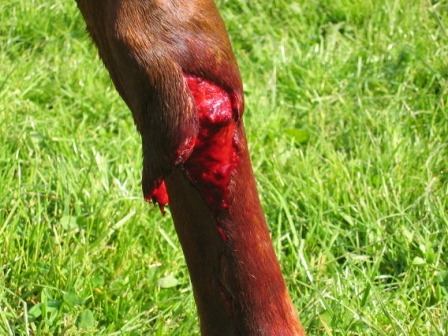
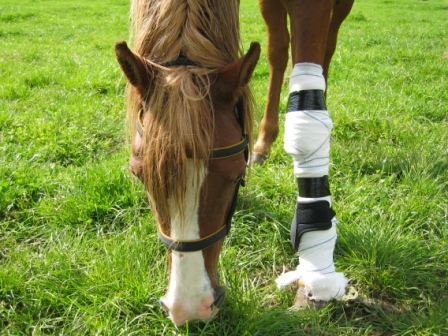
22nd May to 31st May, Camping à la ferme, Croas Men, Finistère, Brittany The first thing we did when we arrived in France was discover that the French don’t have fields, not proper ones anyway with hedges or fences. Instead they have bits of open land with, if you’re lucky, an electric wire running round them. When we asked why they didn’t have proper fields, the answer was something along the lines of “because we’ve discovered electricity”. Still, if you can’t beat ‘em, join ‘em. After a couple of belts on the nose from the mains, the horses are now highly respectful of any bit of wire, tape, even baling twine. The second thing we did was have a horrible accident with Sealeah. We’d given the horses a couple of days off after the ferry and had decided to ride to the beach. A mere quarter of a mile from the campsite, the track took a small stone bridge over a stream. Somehow we’d missed a narrow path through the trees that led to a ford. The bridge was only a couple of feet above the stream bed level and both Hannah and Audin strolled over it without batting an eyelid. Lisa paused for a second on the other side and this left Sealeah and me stuck on the bridge. Sealeah panicked and slipped off into the water, cutting her knee open in the process and collecting a whole array of other cuts all over her legs. It was messy, very messy, blood everywhere, Sealeah freaking out. We led them straight back to the farm, out came the veterinary kit and Lisa set to work stitching her up.
It was going to need a week to heal. We were gutted, and angry with ourselves. It was an accident, but it had been avoidable. Why hadn’t we taken the time to look for a route through the stream? As part of our punishment, the one and only village shop had closed for ten days and the next nearest shop was a ten mile round trip…and there was no bus. At least this kept us fit. The waiting was frustrating, a whole week in one place! After moving on all the time it seemed like forever. We used the time to look around a bit, learn some French and chat with the Bretons. House, stone, dog and mare are ty, maen, ci and caseg in Welsh and, we learned, ty, men, ki and keseg in Breton. These people might as well just admit that they’re Welsh.
1st June to 17th June, Brittany
Sealeah’s leg finally healed, June arrived and we escaped from Croas
Men. We rode to the beach at Loquirec and all five of us were
relieved to be moving again. Just past Morlaix we attempted our
first bit of trespassing. The track was so tempting; it was
From Morlaix, we headed south over the Monts d’Arées. The word
‘monts’ is a bit strong here – these towering giants hardly pierced
the sky with their 300m summits.
One night we stayed at a place which rented out ‘roulottes’ (horse drawn caravans) pulled by the huge Breton horses. The owner explained that it took five years of training before a horse could be trusted to completely ignore the customers’ erratic aids and just get on with following the standard route that it knew by heart. Later on we passed a field with about a dozen of these enormous creatures. They thundered along beside us and I can honestly say the earth moved for all of us. It was probably about five and a half on the Richter scale. From then on, whichever one of us spotted one of these monsters had to shout “Giant Clodhopper Alert!”
After a detour to the Montagnes Noires, we joined the Nantes-Brest
canal at the Manoir de St Péran where we pitched our tent on the
immaculate lawn and put the horses in a small electric paddock – only
there was no electrification, just the wire. We We rang the police, the police rang the mayor, the mayor went back to sleep, we flagged down motorists to ask whether they’d seen three chestnut horses. Nothing. Then, after about three miles, I saw them, standing huddled together, bang in the middle of a huge ploughed field. The sun was just rising, there was a low mist in the valley and it was a beautiful sight. We had no doubt that it was Hannah who had led the escape. To get our own back we teased her about her poor lead mare skills – she’d found the only field for miles around with no grass. Three days later we bought an electric fence kit (made by Copelevage, weighs 2kg).
For a few days through the middle of Brittany the temperature
climbed and climbed, up into the high thirties. We’d been expecting
this further south but not here, not so
At Laniscat, courtesy of the ‘Mairie’, we stayed on the village sports ground. With the horses in a big paddock next to the football pitch, we showered in the Away Team’s dressing room. Can you imagine this happening in Britain, a community providing accommodation for travelling horses?
Things didn’t always turn out quite so well though. We followed the
towpath of the Nantes-Brest canal, croaking with frogs and buzzing
with dragonflies, into the middle of Josselin where a
Rumplestiltskin-style castle dominates the town. We were in need of
a After a two mile walk uphill in the full sun, we eventually located a feed supplier in an out of town industrial estate. The thought of having to return in this heat with 40kg of Alfalfa and a 25kg sack of nuts on my back was making me feel a little negative about our chosen mode of travel. We were used to a bit of physical effort in the mountains, where everyone who’s there has had to work a bit to get there. But an industrial estate? With fat people driving past in big cars? It didn’t seem right. I shared these thoughts with Lisa and she quite rightly told me to shut up. What choice did we have? I considered stealing a supermarket trolley. Luckily, the woman at the feed shop turned out to be an angel sent down from heaven – she offered us a lift back to the horses in her car. She had no idea how much we appreciated that lift. We seemed to go through a period when our ‘rest days’ were anything but restful. Village shops seemed to have become extinct in this part of France and re-stocking usually meant a long walk. After walking into town for a couple of miles from wherever we’d stopped with the horses, we often had to walk another mile or so to an out of town shopping centre to find a supermarket. Like fish out of water, we were pedestrians in a world designed for the car.
Just before the pretty town of Malestroit, we landed on our feet
when we stopped for a couple of nights with Raymond Henriot. An
experienced ‘randonneur à cheval’
The night after leaving Raymond’s place, we bivvied out by a lake
and Hannah got a nasty insect bite on her back. From the beginning,
we’d had a series of problems with
We thought we’d finally sorted things out when the insect bite came along. The bite caused a very slight lump, then the pressure of the saddle over the lump caused an even bigger lump and the cycle continued. Eventually we managed to find some thick foam and create an extra layer of padding with a big hole cut out around the lump. This solved the problem and allowed us to continue. At Redon, we reached the border with the Pays de la Loire region. Despite being only a stone’s throw from the border, the tourist office had no information at all on their neighbouring region, it was almost as if they’d never heard of it. The French seem to be fiercely proud of their régions and départments. Fair enough, but they could at least acknowledge the existence of other areas. All we wanted was a list of campsites. It’s the same with buying maps; you almost have to be on the map before you can find it for sale in a shop. From Redon, it took us three days to reach the Loire and, to be brutally honest, this was not the most exciting countryside we’d ever ridden through. Barley, wheat, oats, more barley, a few cows, nothing to write home about. But when we reached the mighty river itself at Oudon, we knew we were in France: vineyards, a chateau here, another chateau there.
We followed the Loire for the next few days. Described (by the
French) as the last wild river in Europe, it was full of herons,
egrets and terns. We followed some lovely
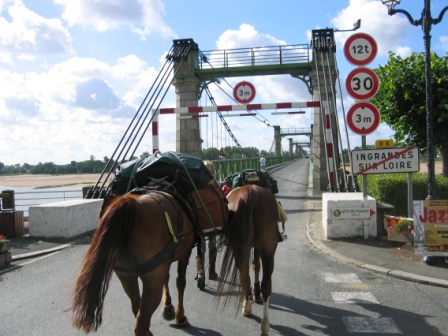
Breathing a large sigh of relief, we arrived at the campsite only to discover that ‘just next door’ meant two miles away…back on the other side of the bridge. Oh how we laughed! But not very much. A temporary sense of humour failure in fact. In the event, the return crossing wasn’t too bad and we arrived at the farm to hear that “of course nobody crosses that bridge with horses anymore”.
At Ingrandes, we finally made it all the way across the Loire. Luckily this time, the bridge was so narrow that the traffic had to queue up behind us as we crossed. More riverbank tracks through vineyards took us to Chalonnes sur Loire and more help from a fellow ‘randonneur’, Damien. A field full of grass, a handful of maps and, over a beer in the bar, advice on a good route for the next day – what more could we ask?
We soon parted company with the Loire and followed the river Layon
through yet more vineyards into the heart of Anjou. For a couple of
nights we couldn’t find anywhere to stay and had to bivi. The French
use the word ‘bivouac’ to mean sleep in the tent. As we always use
the tent, we’ve used it here to mean nights where we’re out
They that sleep near the pond will have frogs for companions
Just past Saumur, home of the French cavalry, we joined the Vienne
river and followed it south to Chinon where we took two rest days. A
very welcome lift to the supermarket spared us the usual trog around
town and we had time to relax a bit, wash
From Chinon, the Vienne and then the Creuse rivers took us deeper
into the heart of France. The vineyards gave way to endless fields
of maize and sunflowers. The going
Accident breed when you over speed
We made the decision to continue on foot until Sealeah recovered. We
had just passed the town of Descartes (I think…) and were heading
towards the Parc de la Brenne. Some long, hard, hot days followed as
we weaved in and out of the hundreds of small lakes that make up the
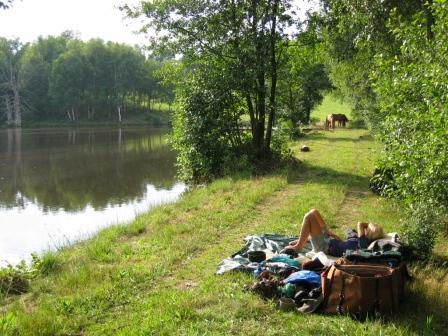
Brenne region. We found ourselves bivvying out for a few
Not far from Eguzon Chantom, tired and hungry, we finally found a proper place to stay at the strangely named American Berry Horse. We were invited in to the house for ‘les aperos’ which then turned into dinner, the most welcome dinner ever. I think they were a bit surprised by our ‘healthy’ appetites. You have to hand it to the French, they know how to eat, and drink, well. Our host was horrified when I offered my glass for a refill of red wine - there was still a tiny sip left in the glass but this was a second bottle and “not the same, not the same!” They take these matters seriously in France. They were into western riding and all aspects of the western horse culture. They laughed at our strange English pronunciation of terms like ‘barrel racing’. It’s the same problem if you ask for a Snickers bar; blank looks unless you say “Sneeekerrrrrrsss”. Anyway, we’ll be eternally grateful for that meal and the kindness they showed us.
The department of Creuse marked the start of a welcome increase in
altitude and the granite underfoot confirmed we’d reached the
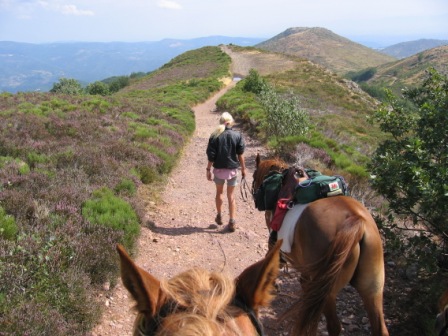
‘Massif Central’. The local paper was even From La Celle Dunoise we followed a beautiful riverbank path through the woods. The path was ‘balisé’ which meant there were splashes of paint all over the trees to mark the way. They just love throwing the paint around. Almost every village has a yellow route, a blue route, a green route. The long distance footpaths (Grandes Randonées, GRs) are always marked with red and white paint. We’d followed lots of bits of GRs and they were an easy way of keeping off the roads as much as possible. Unfortunately, however, there’s no guarantee that these walking routes are possible on a horse.
This particular track became narrower and narrower as it traversed a
45° slope of pines just above the river, but the real problem came
where the path crossed patches
Thanks to Hannah’s colossal rear-end strength, native common sense and agility, she managed to keep her balance and we eventually made it back to safe ground. As usual, Audin had remained totally cool throughout and we’d been able to leave him on his own to follow. Sealeah had done a bit of dancing about ‘off piste’ but come to no harm. We were proud of them – they’d done nothing wrong except follow us. The only damage was a few scratches and one lost shoe. Later that day, I held the horses outside a ‘Mairie’ office while Lisa went to ask for somewhere to stay. Accordion music drifted down from an open window above, followed by a generously bearded face: “Magnifiques! Ils sont magnifiques, les chevaux!” He was right, they were, it was ourselves we were worried about.
As we continued on foot through Creuse, Sealeah’s leg gradually
recovered and we knew we’d soon be back in the saddle. But then
disaster struck at a badly chosen lunch stop. We’d found it hard to
find a place to stop that day: grass but no shade or water, water
and shade but no grass etc. Finally our four hours was up (we didn’t
like to leave Hannah loaded for longer than this at one stretch) and
we stopped in a narrow side So in I went, slipped the head collar on, and quietly suggested to Sealeah that we both get the hell out of there. But she had other ideas. As the bull threw his horns around and pawed the ground bringing up clouds of dust, Sealeah took a few steps but then decided that it would be a good time to answer a call of nature…and just stopped in her tracks. I can’t tell you how long those few seconds lasted, but believe me it was a long time. Eventually she finished and allowed me to lead her away. We spent half an hour repairing the electric fence but Sealeah’s leg was going to take a lot longer – the galloping about had undone all the healing and we were back to square one.
It was in this slightly sorry state that we arrived at a ‘Centre
Equestre’ near Gueret. One horse lame, another with saddle sores and
a shoe missing. We were put on
The contrast with the next place couldn’t have been greater. At a ‘camping à la ferme’ near Moutier d’Ahun the horses were given a field full of good grass and a mineral block – stock farmers understand what animals need. We bought milk, cheese, salad, fruit, vegetables and apple juice – all produced on the farm and all delicious. We took the opportunity to take another rest day while things were going in our favour.
But this happy state didn’t last long. A couple of days later
disaster struck yet again. We were bivvying out by a lake near
Aubusson. The mares were grazing, tethered to Again we cursed and blamed ourselves. Sealeah had become so good and careful on the tether rope that we’d relaxed. We always used a bit of baling twine on the head collar as a weak link in the system but Sealeah’s had worn thin and snapped earlier that day. We hadn’t replaced it. “I’ve learned so much from my mistakes I’m thinking of making a few more”, somebody once said. We seemed to be following this advice but it was becoming painful; it’s so much better learning from other people’s mistakes.
The injuries needed a week to heal and Lisa spent most of this time
on her knees in front of Sealeah, massaging the swollen leg,
changing the bandages and strapping the
During this time at Crocq, the horses were in our electric pen on a playing field on the edge of town. Three horses in a one horse town. We annoyed the woman in the boulangerie by asking every day for ‘pain dur’. This is basically yesterday’s bread, stale and unsold, but it had been a very useful source of additional nutrition for the horses through France. Sometimes we had to pay for it but usually we were give a big sackful for free. The mayor turned out to own horses himself and he saved us by bringing round a big round bale of hay, refusing to accept any payment. As before, the forced stop seemed to go on for ever. It was with great relief that we finally escaped and set off eastwards again, into another sunrise.
We crossed into the Auvergne region and our spirits rose along with
the altitude. We soon passed our previous highpoint of 800m,
achieved three months earlier in the
From the ‘Chaine des Puys’, we turned south to make the most of the
Parc des Volcans. It was about this time, just outside Murol, that
we saw a camel tethered on a
Further south again, we reached the Monts du Cantal. We gained
height steadily up the Plateau du Limon, another vast grazing area,
this one dotted with the ruins of stone ‘burons’ – summer houses for
the herding families. At the top of the Puy de Niermont (1620m) an
international paragliding festival was in full swing. So while the
horses Our joy was dampened on the descent when we found that the GR we’d been following crossed a narrow band of rock with a couple of tricky steps – a horse could easily come off the path and it just wasn’t worth the risk (yes, we were learning). I was about to start crying into my map - the alternative way round was so far it didn’t bear thinking about – when Lisa announced that she’d found a possible descent route. What’s more, it worked! And she’s only the Assistant Chief Navigator! We continued our descent to a perfect wild bivvy spot beneath Puy Mary; tons of grass, a flat spot for the tent and a bubbling mountain stream. We celebrated our 15th anniversary by eating all the food we had left, cheesy tomatoey peanut pasta surprise was the result.
The following day we took a steep zigzag path up to the Col de Cabre,
Sealeah bounding ahead in front, and traversed across to another col
above the ski resort of Super Lioran. Here the horses were
introduced to chairlifts and cable cars for the first time; they
didn’t really understand what it was all about but it was another
excuse for them to get excited. Their first ski run was a blue (no
messing about with the greens) and it took us straight down to the
resort where we found some lush grazing on the nursery slopes. That
afternoon we had another big climb, up to the summit of the Plomb du
Cantal at 1855m, the horses’ highest peak so far. It’s not that big
but they had climbed it from sea level, 800 miles away in Brittany.
Sealeah studied the
It didn’t seem like a drought to us, we’d been rained on and thundered on and lightninged on several times. We later realised that the storms were simply following us and that everywhere had been dry until we turned up in the neighbourhood. Sure enough, on our much-looked-forward-to rest day in St Flour, thunder thundered, lighting flashed and the heavens opened. It was still raining two days later when we took another rest day near Clavières to try and dry out from the soaking we’d had in St Flour. I found out there was a shop in Clavières a couple of miles away. I walked in for supplies but guess what? The shop was closed. This time the excuse was that it was Wednesday. After falling foul of the mysterious Monday closing rule, we’d found the only place in France with Wednesday closing. I trudged back empty handed.
The following day (still raining but now even heavier) we passed by the National Monument to the Resistance and found that 13 civilians had been executed in Clavières by the Nazis in 1944. This put my annoyance at the Wednesday closing into some perspective. Grateful that we hadn’t been trying to do this trip sixty years ago, we carried on up to the top of Mont Mouchet for a view of nothing but mist and rain.
By now we’d crossed into Haute Loire and continued east towards Puy
en Velay. From Saugues to Montbonnet we spent a day on one of the
pilgrim routes to St Jacques de Compostelle. We met more walkers on
that one day than we had in all the days since Brittany put
together. We’d seen the shell symbol on signposts but hadn’t
realised that
On this particular stretch the pilgrims were having a hard time. It was hot and the route dropped 600m into the Allier gorge and then 600m back up again on the other side. All this up and down slowed us a bit too and we had to bivvy out again that night, luckily in a beautiful forest glade with more than enough grass.
The following day, near Cussac-sur-Loire, we crossed the famous
river once more, a month and a half after we’d left it behind back
in Anjou. This time we rode through it and it hardly came above the
fetlocks. We also discovered we were on another ‘Way’,
It turned out that Robert Louis Stephenson had come here to chill out for a bit and then gone for a walk with a donkey down into the Cévennes. As a direct result of this, there was now a positively booming ‘Randonnée avec un ane’ (walk with a donkey) industry. We asked for somewhere to stay and were told we could put the horses in the vast ‘pré aux anes’ (donkey field) and camp there as well – for free. Nice one Robert! Thanks to a sickly Scotsman coming here 130 years ago to get over a woman he couldn’t have and going for a walk with a donkey instead, we had free accommodation right in the middle of town. There was an exhibition all about him in the town’s museum. We saw his ‘Travels with a Donkey’ book and discovered that he’d only gone for twelve days. Twelve days! Pah! All this fuss about him and he only went for twelve days!. To give him his due he did write a couple of good stories as well, I suppose.
For my part, I travel not to go anywhere, but to go.
What have the Romans ever done for us? Ok, apart from the dead
straight road from Monastier going exactly in the direction we
needed? It lifted us quickly up to the higher hills again near Mt
Mézenc. There must have been some kind of Birds of Prey At the gite d’étape beneath Mont Gerbier de Jonc we were told that they were full, and no, we weren’t allowed to pitch the tent, camping was ‘absolutely banned’. Two hundred yards away we found a great camping spot, out of sight, lots of grass and right at the source of the Loire. I can guarantee that nobody’s cup of Loire water tea was fresher than ours that evening. On our first full day in Ardèche it rained solidly all day. By mid-morning we were soaked to the skin and after that we just got wetter and softer and more crinkly. To add to this fun, we were caught out in a thunderstorm on a high ridge. As the thunder got closer and louder, we rounded a corner and saw that the path passed beneath a radio mast. Just as we passed the mast it was struck by lightning and all five of us bolted at once with the shock. Lisa was knocked to the ground by one of Hannah’s panniers (she doesn’t like to bang them on gate posts or trees but has discovered that people just bend and give way…) and we were all a bit shaken. A second strike hit the ground right in front of me with a blinding flash of light. We scurried down off the ridge as fast as our sixteen legs could carry us. That night we were lucky to find a campsite at Intres where the owners, Jean-Pierre and Michelle, let us put the horses in a round pen with a couple of bales of hay. We were invited in for dinner, all delicious and all home grown. After the day we’d had it was more than welcome and we couldn’t thank them enough.
The kindness was repeated again the following day. Late afternoon, nowhere to stay, nowhere practical for a bivvy, a man came out of his farmhouse. We started talking and an hour later we were having dinner with his family while the horses grazed contentedly in his field. We liked Ardèche and not just because of the hospitality; the landscape was beautiful too. I talked with a woman who was trying unsuccessfully to drive her goats down to better grazing. I told her she was lucky to live in a beautiful place. She told me it was ‘poor’ and that they didn’t have enough rain. We carried on along ancient tracks winding through woods of chestnut and oak and emerged on a long high ridge descending towards the Rhone Valley with fantastic views across to the Vercors.
At St Cierge de Serre, a young lad on his bike asked us if the
horses needed a drink and led us to the ‘abreuvoir’ – the drinking
trough/fountain that luckily every village
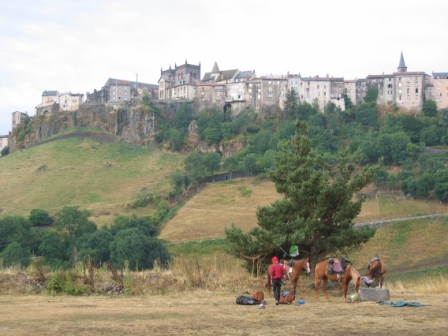
We crossed the Rhone at La Voulte and were rescued yet again by a spontaneous act of kindness. A woman had seen us with the horses and asked if we needed somewhere to stay. We did, our enquiries at the tourist office had drawn a blank. We camped with the horses next to an orchard of peach trees in her huge back garden. In the morning, she brought us a tray with coffee, baguette, butter and honey. The Ardècheans got ten out of ten for hospitality as far as we were concerned. We entered Drome and began searching for a place where we could have an extended rest stop. We found it near the small town of Bourdeaux in the Diois, nestled between the Vercors, the Alps and Provence. We felt the horses would benefit from a longer rest period and Lisa took the opportunity to medicate the joint that had caused Sealeah’s problems. With a bit of time on our hands, we flicked through a tourist brochure and noticed there was a ‘Museum of Coffee Pots and Small Domestic Appliances’. Hmmn…it would be a shame to miss that one…
After the long rest at Bourdeaux we were all glad to get going again
and the horses couldn’t contain their joy as they bounced along the
track heading up to the Col de Chaudiere. Just below the col we
stopped for a night with Chris and Marthe Kiley-Worthington at their
new farm, La Combe. The position was fantastic at the head of a high
valley, and beneath one of the huge limestone cliffs that surround
the Foret de The next few days were a time of zigzags: up steeply to a col, down steeply to a valley, up again and over another col. At Rimon, we camped in a field with a stunning evening view back West. As we watched the sun set behind the furthest ridge, the farmer returned from her vegetable patch and gave us a melon, the freshest we’d ever tasted.
On our last day in Drome, we climbed La Toussiere. On foot because
of the steepness, we could hardly keep up with the horses as they
powered up the slope to the summit. The long descent took us down to Lus La Goix Haute and on to our stop for the night at
Our escape from La Jarjutte was via a stiff 900m climb up to the Col des Aiguilles at 2003m. The push to the col was only interrupted by Hannah spotting a herd of Bouquetin scrambling across a scree slope and insisting that we all stop and stare for a while. The col marked the border with Hautes Alpes, our final departement in France, and the Devoluy area. Later that afternoon we followed a path which contoured across a steep wooded slope down to the village of St Etiene en Devoluy. In a few places, the path crossed bare limestone slabs and skidding hooves gave us a few scary moments – the kind of track that is just about passable with a horse but you wouldn’t want to do again. We camped that night on a patch of communal land in the village. On the edge we found a stinking wolf skin tied to a blood-soaked length of baling twine: a grisly reminder that the re-introduction of wolves to that region has not been without its opponents.
The next day took us over the Col du Noyes (one of the ‘mythical’ cols of the Tour de France apparently) and into the Champsau area. Clouds cleared as we descended hairpin bends and we were rewarded with a fantastic view of the Drac Valley and the peaks of the Massif des Ecrins.
A long day up the Drac Valley ended with a steep pull up to the ski
resort of Orcieres. Running out of options for somewhere to stay, we
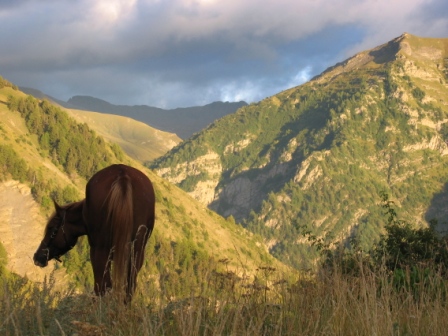
rounded a bend to find “Le Jardin de The following day we were blessed with a perfect clear blue sky. Marmots screamed and ran to their burrows as we weaved our way up to the Col de Freissinieres at 2782m. The descent was very steep at first, the horses placing their feet carefully on the narrow path across the scree. But it soon levelled off into a stunning alpine meadow of sweet mountain grass, criss-crossed with sparkling clear streams. As a lunch stop, it was unbeatable. If April, May, June, July and August had been an excuse for picnics, why not September as well? The next few days were another succession of cols and valleys (Fressinieres, Fournel, Gironde) as we followed the GR50-tour du Haut Dauphine – to Briancon. We knew this area from winter ice climbing trips and it was great to be back. Each night was a bivouac in a high alpine meadow with the horses enjoying both the lush grazing and the views. One morning, up above the Fournel Valley, we watched the first rays of the morning sun hit the high summit of Mont Pelvoux and the Pic Sans Nom. These were special days: sunshine at the end of a long summer, autumn crocuses along the tracks, trees dripping with fruits and berries, wave after wave of peaks in every direction.
Just past Briancon, we reached the hamlet of Les Alberts, a few
miles from the Italian border. Here we had a few days rest while we
waited for the vet to come and sign the export health certificate.
There was no doubt as to the horses’ health. We’d ascended and
descended over 10,000m since leaving Bourdeaux and the horses were
fitter than ever: chestnut coats shining. |

 shown on
the map and would save us a good few miles of road trogging. We were
just about to get away with it as well, when the owner arrived,
blocking our path with his car. Hadn’t we seen the ‘Privé’ sign? We
were forced into playing the
stupid-foreign-tourist-who-doesn’t-understand-a-word-of-French,
card, perhaps taking it a bit far with our ‘dumb and dumber’
routine. He looked a bit perplexed but carefully explained that it
meant ‘private’ in English. “Oh of course! How could we have been so
stupid!”, our faces replied. By this time, the man was quite pleased
that he’d managed to get his point across to such a pair of half
wits. He let us through with a smile.
shown on
the map and would save us a good few miles of road trogging. We were
just about to get away with it as well, when the owner arrived,
blocking our path with his car. Hadn’t we seen the ‘Privé’ sign? We
were forced into playing the
stupid-foreign-tourist-who-doesn’t-understand-a-word-of-French,
card, perhaps taking it a bit far with our ‘dumb and dumber’
routine. He looked a bit perplexed but carefully explained that it
meant ‘private’ in English. “Oh of course! How could we have been so
stupid!”, our faces replied. By this time, the man was quite pleased
that he’d managed to get his point across to such a pair of half
wits. He let us through with a smile.  Still,
it was good to be getting some views again. We rode on through the
beautiful forest of Huelgoat with its magical granite boulders and
wetland meadows full of ragged robin and flag iris.
Still,
it was good to be getting some views again. We rode on through the
beautiful forest of Huelgoat with its magical granite boulders and
wetland meadows full of ragged robin and flag iris.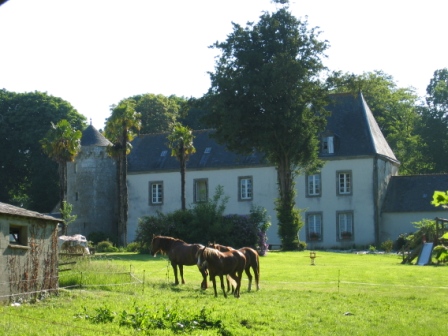 woke at 6am and our
worst nightmare had come true: the horses were gone. The wire had
been broken, a trail of horseshoe prints led across the
no-longer-immaculate lawn and scratch marks on the road showed
they’d headed back the way we’d come the day before. Full panic mode
ensued.
woke at 6am and our
worst nightmare had come true: the horses were gone. The wire had
been broken, a trail of horseshoe prints led across the
no-longer-immaculate lawn and scratch marks on the road showed
they’d headed back the way we’d come the day before. Full panic mode
ensued.  soon. At 36°C Lisa just
about stops being cold and I just about stop being able to stand up.
The combination of dawn starts, hot weather and too much camembert
made me fall asleep nearly every lunchtime. I tried bravely to
defend the many benefits of the continental-style siesta system but
Lisa ended up doing more of the work and she wasn’t happy.
soon. At 36°C Lisa just
about stops being cold and I just about stop being able to stand up.
The combination of dawn starts, hot weather and too much camembert
made me fall asleep nearly every lunchtime. I tried bravely to
defend the many benefits of the continental-style siesta system but
Lisa ended up doing more of the work and she wasn’t happy. ‘town’ stop, a rest day to restock and sort out a few things. The
woman at the gite d’etape (hostel) had told us that she had three
horse paddocks. When we arrived our faces fell, a chicken would have
felt claustrophobic in one of these tiny pens, 100% grass-free and
‘fenced’ with the kind of floppy green plastic joke netting that
people put around their suburban flower beds. At the end of another
long day, our ‘rest’ had suddenly turned into a struggle to find
horse food.
‘town’ stop, a rest day to restock and sort out a few things. The
woman at the gite d’etape (hostel) had told us that she had three
horse paddocks. When we arrived our faces fell, a chicken would have
felt claustrophobic in one of these tiny pens, 100% grass-free and
‘fenced’ with the kind of floppy green plastic joke netting that
people put around their suburban flower beds. At the end of another
long day, our ‘rest’ had suddenly turned into a struggle to find
horse food. himself, he knew exactly what it
was like to travel with horses and he helped us in every way he
could. Food for the horses, a hot shower for us… aperitifs, dinner,
red wine, white wine, another bottle of red. We were still swapping
stories at half past midnight when the ‘eau de vie’ bottle came out.
Served with hot water and a spoonful of sugar this went down the
throat like…well, it went down very easily, too easily. The next
day, Raymond had to go to work but he had arranged for his farrier
to come and shoe our horses. What’s more, he left his bicycle and a
map of how to get into town if we needed anything. What a star! We
couldn’t thank him enough and left in much higher spirits than when
we’d arrived.
himself, he knew exactly what it
was like to travel with horses and he helped us in every way he
could. Food for the horses, a hot shower for us… aperitifs, dinner,
red wine, white wine, another bottle of red. We were still swapping
stories at half past midnight when the ‘eau de vie’ bottle came out.
Served with hot water and a spoonful of sugar this went down the
throat like…well, it went down very easily, too easily. The next
day, Raymond had to go to work but he had arranged for his farrier
to come and shoe our horses. What’s more, he left his bicycle and a
map of how to get into town if we needed anything. What a star! We
couldn’t thank him enough and left in much higher spirits than when
we’d arrived.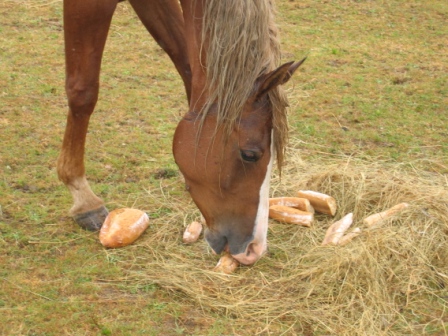 Hannah’s load and, to our great
shame, these had caused some saddle sores. Due to the rapid increase
in work, she changed shape but we failed to adjust the saddle
quickly
Hannah’s load and, to our great
shame, these had caused some saddle sores. Due to the rapid increase
in work, she changed shape but we failed to adjust the saddle
quickly enough to match. We left it wider than it should have been
and this caused it to roll. We thought the rolling was causing the
problem so we tightened the girth. We’d been desperately keen to
avoid sores and had tried everything, but with Hannah we’d failed.
We stripped the weight of her load down as much as possible and she
carried it so cheerfully, you’d never know there was a problem, but
the white hair on her back is a constant reminder of our failure.
enough to match. We left it wider than it should have been
and this caused it to roll. We thought the rolling was causing the
problem so we tightened the girth. We’d been desperately keen to
avoid sores and had tried everything, but with Hannah we’d failed.
We stripped the weight of her load down as much as possible and she
carried it so cheerfully, you’d never know there was a problem, but
the white hair on her back is a constant reminder of our failure. wooded
tracks along the north bank but then had a grim experience crossing the
bridge at St Florent. We’d been told that we could keep the horses
‘juste à coté’ (just next door) to a campsite. The campsite was on an
island and the bridge to reach it carried a main road. We’d already
discovered that many French drivers don’t bother slowing down for
horses, but to make things worse this bridge was narrow and the lorries
were big. Lisa had a rough time trying to keep Hannah and Audin calm.
However good they’ve become in traffic, a 40-tonne wagon still looks
big and scary when it roars past. Even when they do slow down, the hiss
of the air brakes can lead to a bit of ‘lateral work’ by the horses.
wooded
tracks along the north bank but then had a grim experience crossing the
bridge at St Florent. We’d been told that we could keep the horses
‘juste à coté’ (just next door) to a campsite. The campsite was on an
island and the bridge to reach it carried a main road. We’d already
discovered that many French drivers don’t bother slowing down for
horses, but to make things worse this bridge was narrow and the lorries
were big. Lisa had a rough time trying to keep Hannah and Audin calm.
However good they’ve become in traffic, a 40-tonne wagon still looks
big and scary when it roars past. Even when they do slow down, the hiss
of the air brakes can lead to a bit of ‘lateral work’ by the horses.

 on our
own somewhere, rather than on a farm or campsite. Near Martigny
Briand, we bivvied on a broad footpath, well hidden from view by
high hedges. Our water came from a depressingly small and
disturbingly green pond. That night we dined on a delicious bowl of
‘pondlife’ soup, washed down with a lovely cup of ‘pondlife’ tea.
It’s not always easy to find the perfect bivi site; we made a mental
note to try harder next time – flowing water would be nice. The next
night we did find flowing water, a beautiful quiet riverbank with a
family of beavers coming out to play at sunset. Bonuses like that
help to offset the stress of having to find somewhere to stop when
it’s late, everyone’s hungry and things are starting to look a bit
grim.
on our
own somewhere, rather than on a farm or campsite. Near Martigny
Briand, we bivvied on a broad footpath, well hidden from view by
high hedges. Our water came from a depressingly small and
disturbingly green pond. That night we dined on a delicious bowl of
‘pondlife’ soup, washed down with a lovely cup of ‘pondlife’ tea.
It’s not always easy to find the perfect bivi site; we made a mental
note to try harder next time – flowing water would be nice. The next
night we did find flowing water, a beautiful quiet riverbank with a
family of beavers coming out to play at sunset. Bonuses like that
help to offset the stress of having to find somewhere to stop when
it’s late, everyone’s hungry and things are starting to look a bit
grim. all
the tack and make some repairs. The next day we were almost normal
tourists and had time for a stroll around. It turned out that Joan of
Arc had shouted at some of her soldiers in the town square and that
Richard the Lionheart had popped in for a couple of nights at the
chateau on his way to a fight somewhere – we were in good company. As
we ate lunch sitting under a statue on the quay, some lowlife decided
to steal a bag containing our camera and address book – all the
addresses of everybody we’d stayed with and wanted to write and thank.
We drowned our sorrows with a bottle of the local red.
all
the tack and make some repairs. The next day we were almost normal
tourists and had time for a stroll around. It turned out that Joan of
Arc had shouted at some of her soldiers in the town square and that
Richard the Lionheart had popped in for a couple of nights at the
chateau on his way to a fight somewhere – we were in good company. As
we ate lunch sitting under a statue on the quay, some lowlife decided
to steal a bag containing our camera and address book – all the
addresses of everybody we’d stayed with and wanted to write and thank.
We drowned our sorrows with a bottle of the local red. was hard. There were too many
roads and stony tracks and we went too quickly, too much fast
trotting. Perhaps we were in a hurry to get to the hills again.
Whatever the reason, it was a mistake because Sealeah went lame. It
may have been one bad stumble on a road verge, or some cumulative
effect from all the hard roads and rough verges, but the result was
the same: she was lame. More haste, less speed. The slower you go,
the faster you get there. Wise words and annoyingly true.
was hard. There were too many
roads and stony tracks and we went too quickly, too much fast
trotting. Perhaps we were in a hurry to get to the hills again.
Whatever the reason, it was a mistake because Sealeah went lame. It
may have been one bad stumble on a road verge, or some cumulative
effect from all the hard roads and rough verges, but the result was
the same: she was lame. More haste, less speed. The slower you go,
the faster you get there. Wise words and annoyingly true. nights
running…and then we ran out of food. It’s hard to imagine how this
can happen in Western Europe in peacetime but we managed it. Just
choose a route with as few roads as possible and pass through only
the smallest villages - where the shops are always closed or just
don’t exist. Closed on a Sunday, fair enough, but Monday too? Do
they need a rest after the weekend? Our supplies dwindled down to
nothing. The combination of not eating and walking 20 miles a day
was quite an effective weight loss plan but one that we could have
done without. We spotted a bigger looking village on the map and
made a detour to reach it, fantasising about emptying the shelves of
the patisserie. When we got there, the shelves were already empty –
the village shop was up for sale. The rest of the village had
already been bought by retired English couples (probably).
nights
running…and then we ran out of food. It’s hard to imagine how this
can happen in Western Europe in peacetime but we managed it. Just
choose a route with as few roads as possible and pass through only
the smallest villages - where the shops are always closed or just
don’t exist. Closed on a Sunday, fair enough, but Monday too? Do
they need a rest after the weekend? Our supplies dwindled down to
nothing. The combination of not eating and walking 20 miles a day
was quite an effective weight loss plan but one that we could have
done without. We spotted a bigger looking village on the map and
made a detour to reach it, fantasising about emptying the shelves of
the patisserie. When we got there, the shelves were already empty –
the village shop was up for sale. The rest of the village had
already been bought by retired English couples (probably).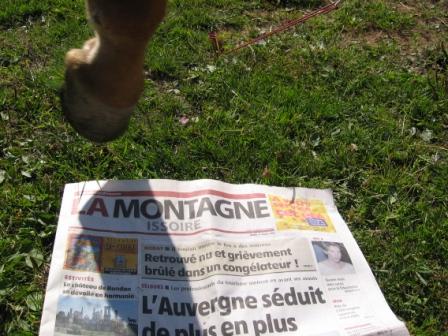 called ‘Montagne’ which
was going a bit far – Creuse is hilly but a lot more like
Carmarthenshire than the Alps. In fact it was exactly like
Carmarthenshire, just a lot warmer and without so many sheep. Monet
and his impressionist mates must have liked it because they used to
hang out here all the time in their summer holidays.
called ‘Montagne’ which
was going a bit far – Creuse is hilly but a lot more like
Carmarthenshire than the Alps. In fact it was exactly like
Carmarthenshire, just a lot warmer and without so many sheep. Monet
and his impressionist mates must have liked it because they used to
hang out here all the time in their summer holidays.  of scree and rocks. We should have
turned back but the path had become so narrow that it was actually
difficult to turn around, and we knew that the only alternative was
a long walk round on the road. If we could just get past this next
section… In the end we were forced into retreating due to a boulder
field. We watched in horror as Hannah’s panniers kept catching on
trees and pushing her off the path, her feet skidding on the rocks
above the river. Why had we been so stupid as to get into this
position? What was the point in taking risks when we were in this
for the long haul?
of scree and rocks. We should have
turned back but the path had become so narrow that it was actually
difficult to turn around, and we knew that the only alternative was
a long walk round on the road. If we could just get past this next
section… In the end we were forced into retreating due to a boulder
field. We watched in horror as Hannah’s panniers kept catching on
trees and pushing her off the path, her feet skidding on the rocks
above the river. Why had we been so stupid as to get into this
position? What was the point in taking risks when we were in this
for the long haul? track off the road. There was water, grass and shade but not much room
for all five of us. Suddenly, Sealeah spotted a gap in the hedge and
stumbled through a knee high electric fence hidden in the long grass.
She found herself in a huge field full of Charolais cows and a big
bull. Attacked by the electric wire and threatened by the bull, her
response was to start galloping flat out, round and round the field, in
and out of a stream, through another electric wire. She looked
magnificent but this wasn’t a planned part of her rehabilitation
towards full soundness. The bull looked angry, the bull was angry.
Eventually Sealeah stopped galloping and started grazing, cool as a
cucumber…and only ten yards from the bull. At this point, Lisa informed
me that Sealeah was my horse, which meant that I had to go and catch
her. I couldn’t even use the “But you’re the vet!” approach that comes
in so handy for most horse-related tasks that I try and get out of
doing.
track off the road. There was water, grass and shade but not much room
for all five of us. Suddenly, Sealeah spotted a gap in the hedge and
stumbled through a knee high electric fence hidden in the long grass.
She found herself in a huge field full of Charolais cows and a big
bull. Attacked by the electric wire and threatened by the bull, her
response was to start galloping flat out, round and round the field, in
and out of a stream, through another electric wire. She looked
magnificent but this wasn’t a planned part of her rehabilitation
towards full soundness. The bull looked angry, the bull was angry.
Eventually Sealeah stopped galloping and started grazing, cool as a
cucumber…and only ten yards from the bull. At this point, Lisa informed
me that Sealeah was my horse, which meant that I had to go and catch
her. I couldn’t even use the “But you’re the vet!” approach that comes
in so handy for most horse-related tasks that I try and get out of
doing. prominent display in a paddock full
of weeds. Having arranged for a farrier to come the next day, we had
to stay but it wasn’t much fun. Creuse is cattle country and we’d
walked past fields full of lush grass all day. Here our horses had
to stand in piles of weeds and horseshit. What’s more, everyone came
over to have a good look at all the injuries and saddle sores,
suggesting all kinds of probably harmless but utterly useless creams
and potions. Their horses didn’t have a mark on them of course; they
just weaved and windsucked and went out of their minds in their
solitary confinement cells that we call stables.
prominent display in a paddock full
of weeds. Having arranged for a farrier to come the next day, we had
to stay but it wasn’t much fun. Creuse is cattle country and we’d
walked past fields full of lush grass all day. Here our horses had
to stand in piles of weeds and horseshit. What’s more, everyone came
over to have a good look at all the injuries and saddle sores,
suggesting all kinds of probably harmless but utterly useless creams
and potions. Their horses didn’t have a mark on them of course; they
just weaved and windsucked and went out of their minds in their
solitary confinement cells that we call stables.  trees while we gave Audin a bath in the warm water of the lake. Suddenly something
startled Hannah, our Chief of Security, and she bolted. Sealeah
followed suit but unfortunately had the tether rope between her
legs. As the rope came taught, it wrapped tightly around her front
leg, her good front leg. It was a mess but didn’t appear to be too
bad until halfway through the next day when she became very lame.
Lisa was worried; I was worried because Lisa was worried; what if
the tendons were damaged? We limped into the small town of Crocq and
ended up staying for a week.
trees while we gave Audin a bath in the warm water of the lake. Suddenly something
startled Hannah, our Chief of Security, and she bolted. Sealeah
followed suit but unfortunately had the tether rope between her
legs. As the rope came taught, it wrapped tightly around her front
leg, her good front leg. It was a mess but didn’t appear to be too
bad until halfway through the next day when she became very lame.
Lisa was worried; I was worried because Lisa was worried; what if
the tendons were damaged? We limped into the small town of Crocq and
ended up staying for a week. other leg to help it take
the extra load. Lisa wasn’t happy until she’d checked out the
tendons. The local vet, by his own admission, knew nothing about
horses but he had an ultrasound scanner and he very kindly let Lisa
borrow it. Even more kindly, he didn’t charge us a centime. It was a
huge relief to find that the tendons were OK. Another lucky escape
but a reminder of the risks and the need to be careful.
other leg to help it take
the extra load. Lisa wasn’t happy until she’d checked out the
tendons. The local vet, by his own admission, knew nothing about
horses but he had an ultrasound scanner and he very kindly let Lisa
borrow it. Even more kindly, he didn’t charge us a centime. It was a
huge relief to find that the tendons were OK. Another lucky escape
but a reminder of the risks and the need to be careful.

 Black Mountains of Wales.
Volcanoes appeared on the horizon and before long we were amongst
them: Puy de Dome, Puy des Vaches…a whole chain of Puys. A mere
seven or eight thousand years ago, these were spewing out lava but
now the slopes were wooded and the forest glades were thick with
lush green grass – perfect riding country. And we were finally
riding again. After two hundred and twenty miles on foot, Sealeah
had finally come sound again. By way of a bonus, all that walking
had left us feeling pretty fit as well.
Black Mountains of Wales.
Volcanoes appeared on the horizon and before long we were amongst
them: Puy de Dome, Puy des Vaches…a whole chain of Puys. A mere
seven or eight thousand years ago, these were spewing out lava but
now the slopes were wooded and the forest glades were thick with
lush green grass – perfect riding country. And we were finally
riding again. After two hundred and twenty miles on foot, Sealeah
had finally come sound again. By way of a bonus, all that walking
had left us feeling pretty fit as well. road verge. This experience came a bit
earlier than we’d been expecting on the trip and the horses’ ears
gave away their surprise. It turned out the circus was in town. In
the Massif du Sancy we followed some great upland tracks past the
Lac de Pavin _ a perfectly formed crater lake – and the Lac de
Montcinyere. Next came the Monts de Cezallier, a vast open space of
high plateaux, grazed by the local ‘Salers’ cattle. The haymaking
was in full swing and tractors were busy everywhere: cutting,
tedding, baling and carting. The sight of Hannah, loaded up and
working, seemed to attract older farmers who remembered working with
horses. A man of eighty one told us how he’d got his first tractor
in 1976; before that, he’d done all the work with horses.
road verge. This experience came a bit
earlier than we’d been expecting on the trip and the horses’ ears
gave away their surprise. It turned out the circus was in town. In
the Massif du Sancy we followed some great upland tracks past the
Lac de Pavin _ a perfectly formed crater lake – and the Lac de
Montcinyere. Next came the Monts de Cezallier, a vast open space of
high plateaux, grazed by the local ‘Salers’ cattle. The haymaking
was in full swing and tractors were busy everywhere: cutting,
tedding, baling and carting. The sight of Hannah, loaded up and
working, seemed to attract older farmers who remembered working with
horses. A man of eighty one told us how he’d got his first tractor
in 1976; before that, he’d done all the work with horses.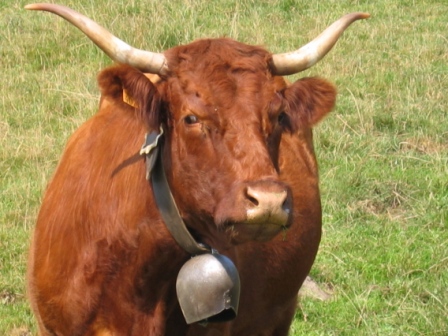 stood transfixed by the strangest birds they’d ever seen, we
took in the superb mountain view. We’d been told by many people that
the Cantal was beautiful and they were right.
stood transfixed by the strangest birds they’d ever seen, we
took in the superb mountain view. We’d been told by many people that
the Cantal was beautiful and they were right.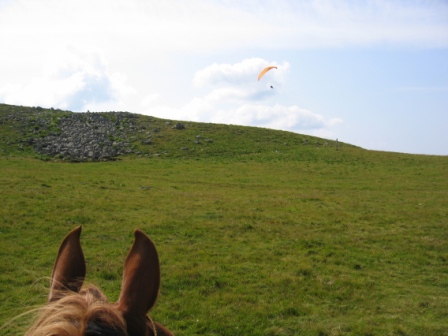


 viewpoint table with great interest but we had
to pull her away when she started trying to eat it. We looked east
towards St Flour and it seemed like a different country; the green
had turned to brown, a second drought year after the extreme drought
of 2003.
viewpoint table with great interest but we had
to pull her away when she started trying to eat it. We looked east
towards St Flour and it seemed like a different country; the green
had turned to brown, a second drought year after the extreme drought
of 2003.

 the pilgrimage was so popular. A man who’d walked all
the way from Holland (complete with shell on rucksack) tried to
enlighten us: an apostle was shipwrecked off northern Spain, a
shepherd saw some funny lights in the sky, somebody built a big
church and thousands of catholic pilgrims walk there from the
furthest corners of Europe. It was whilst thinking about these
motives that we suddenly thought: Hang on! What’s our excuse? We
don’t even know where we’re going and we haven’t even told our
parents what time we’ll be back. I doubt if we’ll get to light a
candle at the end of it either.
the pilgrimage was so popular. A man who’d walked all
the way from Holland (complete with shell on rucksack) tried to
enlighten us: an apostle was shipwrecked off northern Spain, a
shepherd saw some funny lights in the sky, somebody built a big
church and thousands of catholic pilgrims walk there from the
furthest corners of Europe. It was whilst thinking about these
motives that we suddenly thought: Hang on! What’s our excuse? We
don’t even know where we’re going and we haven’t even told our
parents what time we’ll be back. I doubt if we’ll get to light a
candle at the end of it either. this
time the ‘Chemin de Francois Regis’ This bloke had gone all over these
parts a few centuries ago, desperately trying to save the people from
the horrors of Protestantism. I bet he didn’t let on that they ‘d have
to walk all the way to Spain carrying a shell. His route led us to
Monastier-sur-Gazeille and, we could hardly believe it, yet another
‘Chemin’ started here, the ‘Chemin de Stephenson’.
this
time the ‘Chemin de Francois Regis’ This bloke had gone all over these
parts a few centuries ago, desperately trying to save the people from
the horrors of Protestantism. I bet he didn’t let on that they ‘d have
to walk all the way to Spain carrying a shell. His route led us to
Monastier-sur-Gazeille and, we could hardly believe it, yet another
‘Chemin’ started here, the ‘Chemin de Stephenson’. Conference
going on because the sky was full of them: buzzards, kites, hawks
and kestrels. Soon we were crossing into Ardèche and the Rhone-Alpes
region – wow, that sounded good to us, the ‘Alpes’ bit. It sounded
like a long way from the Mynydd Du that we’d left behind in Wales.
Conference
going on because the sky was full of them: buzzards, kites, hawks
and kestrels. Soon we were crossing into Ardèche and the Rhone-Alpes
region – wow, that sounded good to us, the ‘Alpes’ bit. It sounded
like a long way from the Mynydd Du that we’d left behind in Wales.

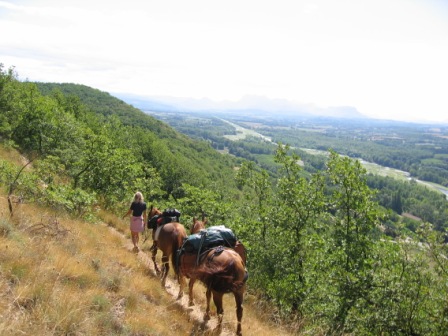 seems to possess. As the
horses drank, people came out of their houses and over for a chat:
“Ils sont beaux, les chevaux” (they’re beautiful, the horses). We
must have heard these words nearly everyday in France and they’d led
to a hundred conversations that always started like this:
seems to possess. As the
horses drank, people came out of their houses and over for a chat:
“Ils sont beaux, les chevaux” (they’re beautiful, the horses). We
must have heard these words nearly everyday in France and they’d led
to a hundred conversations that always started like this: 


 Siou. On top of all their horse activities, they’re
working hard to establish the farm and become as self sufficient as
possible.
Siou. On top of all their horse activities, they’re
working hard to establish the farm and become as self sufficient as
possible.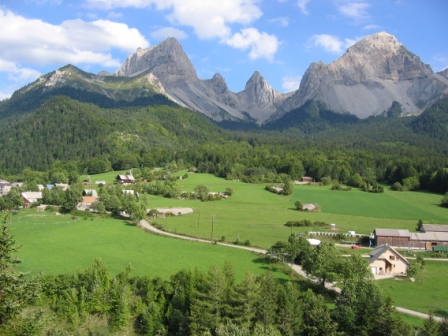 La Jarjutte.
This felt much more like an alpine village with high rocky peaks on
all sides, beds of limestone folded up at crazy angles and steep
valley slopes covered with pines.
La Jarjutte.
This felt much more like an alpine village with high rocky peaks on
all sides, beds of limestone folded up at crazy angles and steep
valley slopes covered with pines.
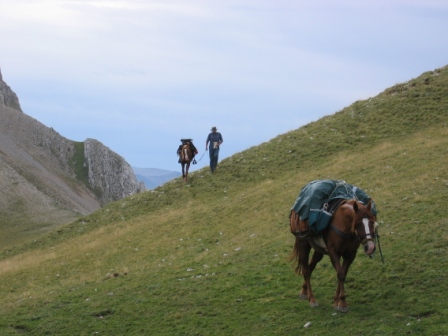
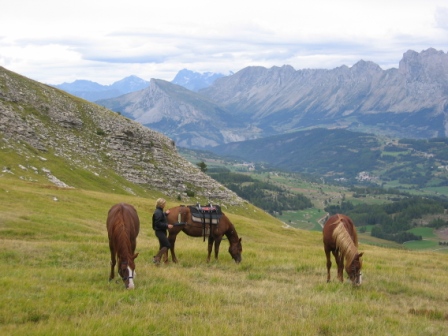
 Piou-Piou” a kind of crèche
area for infant skiers, complete with pond and miniature ski lift.
It was perfect for us: grass, water and a great view. So despite the
slightly worrying name we decided it would do the job. We fell
asleep, safe in the knowledge that we were being watched over by an
enormous plastic bear.
Piou-Piou” a kind of crèche
area for infant skiers, complete with pond and miniature ski lift.
It was perfect for us: grass, water and a great view. So despite the
slightly worrying name we decided it would do the job. We fell
asleep, safe in the knowledge that we were being watched over by an
enormous plastic bear.

